
Declaring Interdependence
On the 250th Fourth of July, I gave a talk about the promise we still haven't finished keeping, and three ways to help build what comes next.
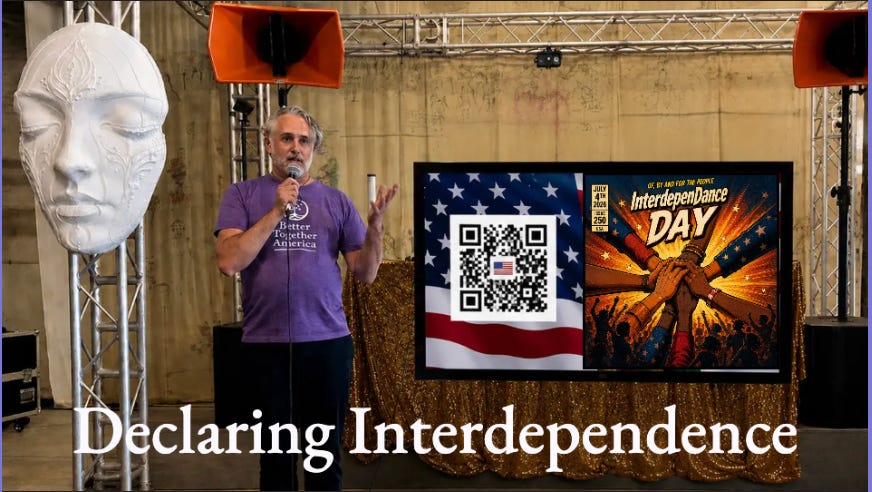
Two hundred and fifty years ago, a group of people sat down at a crossroads. They were disappointed in their government — taxes, corruption, distant elites managing their business, being dragged into weird wars in other places.
Sound familiar?
On the 250th Fourth of July, I got up at an Interdependence Day gathering in Oakland and talked about the part of the founding story we tend to skip: the first step wasn’t the Constitution. It was a declaration. Here’s the talk, about thirteen minutes.
If you’d rather read than watch, here’s the short version — and three invitations to do something with it.
We don’t have to skip to step two
The founders didn’t have an answer either. In 1776 they just had a declaration, and it did a few simple things: it named the values they believed in, it listed their grievances, and then they pledged “to each other our lives, our fortunes, and our sacred honor.” Then came eight years of war, and five more years before the Constitution was sorted out.
We don’t have to jump to step two. We can start where they started — with a declaration to each other:
We’re united. Stop trying to divide us.
That thread of interdependence is the whole point. We’re not separating from anything. We’re refusing to be separated from each other. (I wrote more about why we need this now here: ⟢“It’s Time for a New American Declaration”⟣.)
What would it look like to thrive in 2276?
I’ve been haunted by an essay called “The Fate of Empires” by the historian Sir John Glubb, who found that civilizations tend to burn through about ten generations — roughly two hundred and fifty years — and then hit a failed state. National debt, internal division, everyone bickering, worship of celebrities and sports figures.
We tick off all the boxes for a failed civilization about to collapse.
But whether or not his theory holds, that’s not really the point. The point is the question almost nobody’s asking:
What would it look like to thrive in another two hundred and fifty years? What would it look like to thrive in 2276?
That question is now a place you can go. It’s called the Archive of the Future — a collection of the stories of what we did right now, and what history will say about our time. Add yours: ⟢2276.us⟣. (More on why I built it: ⟢“What Will Historians Say About Us?”⟣.)
Build it where you live
We can’t wait for Washington to fix this, and we can’t count on one party winning once and for all. It’s like sports — you don’t win the game, or the election, once and for all. You have to keep playing together.
What the whole pro-democracy movement keeps rediscovering is that we have to go local. We already have the tools — mediation, dialogue, deliberative democracy, town halls that actually work. We’re just not using them.
We already have the solutions to all these democracy problems. We’re just not using them, for some reason.
My favorite image for how this could work is a strangling fig:
It’s a bunch of little vines that drop around a tree — hundreds of them. They hold that tree in place for decades. But eventually they build a beautiful, massive tree encasing the whole thing — and it lasts for centuries. That’s the energy I want to think about.
That’s the strategy: build the scaffolding locally, feed the old system good information, and let something stronger grow up around it. (I laid this out in full here: ⟢“The Strangler Fig Theory”⟣.)
Three invitations
Breaking my own rule about having just one call to action:
Help define the principles of “America 2.50.” Add your voice to the conversation now:
“If you were to re-design how the whole world works, what essential parts of a new global system would you create?”Come build with us locally. ⟢Better Together America & East Bay Civic Hub⟣.
Tell the future what we did. Go to ⟢2276.us⟣ and share your vision for how we pull this magic trick off.
Frederick Douglass said it best about the first declaration — and it’s just as true about the one we get to make now:
“I have said that the Declaration of Independence is the ring-bolt to the chain of your nation's destiny… The principles contained in that instrument are saving principles. Stand by those principles, be true to them on all occasions, in all places, against all foes, and at whatever cost.”
Whether or not the founders fully believed it doesn’t matter. The question is whether we do. Do we want to be doing this right? Yes. So let’s declare it.
We are the ones building the future. It’s always been true.