
It’s Time for a New American Declaration
Why The United People of America need to Declare Interdependence
Hey, everyone. It’s been a while. I’ve been busy putting together this educational series for the Democracy movement. I’m returning to writing again now, because I have a lot to say about this moment.
This weekend in Philadelphia I attended the Braver Angels Convention where Reds and Blues from across the country debated whether we are living up to the Founders’ vision, crafted civic visions together, and recommitted ourselves to one another and to our country. The convention’s theme was A Pledge Renewed, drawn from the Declaration’s final line: “we mutually pledge to each other our Lives, our Fortunes and our sacred Honor.”
At one point, we sang a modified version of “From Now On” from The Greatest Showman. I cried harder than I expected. For a moment, the idea at the center of this essay became real: this American experiment is worth fighting for, and it has always depended on whether we are willing to remain bound to one another long enough to make it work.
The question is not only whether we still believe in America. It is whether we still believe in each other enough to continue the experiment.
250 Years
So here we are.
The United States is approaching it’s 250th birthday, the anniversary of the Declaration of Independence. There are plenty of ways to meet this moment. You can celebrate. You can protest. You can grieve, critique, commemorate, ignore, or actively anti-celebrate. You can feel proud of the country, furious with it, frightened for it, sad for it, alienated from it, or several of those things at once like me.
Whatever your relationship to the anniversary, this moment matters. It’s an opportunity to reflect where we are, how we got here and recommit to each other to continue this American project into the future. Recommitment and clarity will be necessary, because the odds are stacked against our success.
Based on his study of a wide range of past civilizations, Glubb identified a recurring pattern: great powers often lasted roughly 250 years, or about ten generations. He described their final stage as one marked by intensifying internal political hatred, pessimism, materialism, defensiveness, declining public duty, and an increasingly fragile economic order built on debt, consumption, and the assumption that prosperity will continue indefinitely.
Some of Glubb’s conclusions are dated, and I do not treat his theory as a law of history. But the specificity is what haunts me. A society growing richer while becoming less capable of sacrifice. Public life turning toward spectacle. Political factions becoming more vicious as the country becomes more vulnerable. An economic house of cards maintained because no one can imagine what happens when the assumptions underneath it fail.
I recognize enough of that pattern to feel afraid.
And the flashing warning lights are not exactly subtle.
People across the political spectrum believe the country is in serious trouble. We disagree about the causes, the villains, and the solutions, but dissatisfaction is everywhere. People feel unrepresented, manipulated, economically squeezed, culturally displaced, and increasingly doubtful that the systems governing our collective lives are capable of handling what comes next.
The thing that scares me most, is that collectively we seem to believe two contradictory things at once:
The thing that scares me most is that collectively we seem to believe two contradictory things at once:
The current system is not working and cannot continue like this.
Nothing fundamentally different is possible because this is the best we can do.
As I’ve said before, there is a third possibility: the system can be improved, and it is up to us to make that happen.
Fortunately, we do not need to redesign the whole country overnight. We do not yet need to believe we can solve everything.
We only need to do what the founders did first.
We need to make a declaration:
Based on our shared values, this is not good enough.
We are united in our demand that things improve.
This Has Happened Before
The conditions of 2026 are obviously not the conditions of 1776. But we can recognize the frustrations of the people living in the colonies before the Revolution, because some of them resemble our own.
They believed they were governed by people and institutions that are far away, out of touch and not adequately representing them. They objected to taxation and tariffs, military decisions, and being dragged into conflicts they did not control. The saw judges controlled by the king and interference in elections. They petitioned, argued, organized, resisted, and tried to repair the relationship, but their government refused to hear them.
The Declaration of Independence came after years of accumulating grievances and failed attempts at redress.
And when it came, its basic structure was remarkably simple.
The Declaration named values and claimed rights that do not come from government. It claimed that government exists to secure those rights. It claimed that legitimate power comes from the consent of the governed. Then it listed grievances showing how the existing government had violated those principles.
It said that the situation had crossed a threshold; it could no longer continue.
Finally, it closed with a mutual pledge to support the declaration and accept the risks that followed.
That was the Declaration.
The design came later.
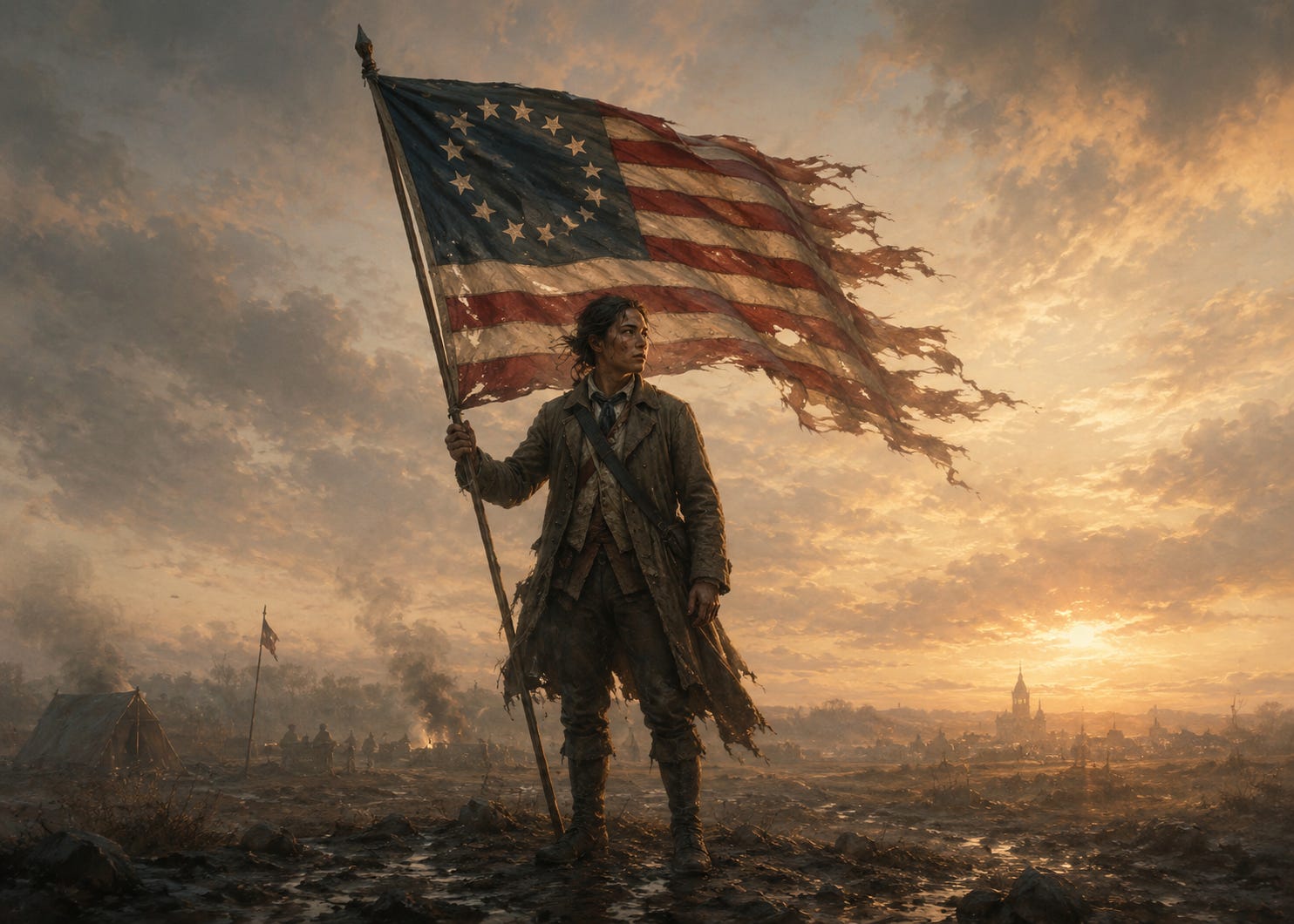
The new nation spent thirteen years experimenting before the Constitution took effect in 1789. Even then, the system had not yet proven that it could survive genuine partisan conflict. That test came in 1800, when power transferred from one political faction to another through an election rather than violence.
So the revolution was not one clean event. It was a process:
Declaration.
Design.
Implementation and iteration.
It took roughly a quarter-century.
That is good news.
It means we do not need to agree yet what the country should look like in 2050, much less 2276. We don’t need do fully redesign the operating system, YET. Before we can do any of that we need become clear about what we believe and declare that it’s worth fighting for.
It Is Time for a New Declaration
The declaration we need to make will not be a declaration of separation from a foreign king.
Our problem is not that some external ruler governs us without consideration. It’s that it feels that way with our own government.
The systems we have built are no longer adequately serving the people they supposedly represent, and the declaration itself says, “…whenever any Form of Government becomes destructive of these ends, it is their right, it is their duty, to throw off such Government, and to provide new Guards for their future security.”
So what would a new declaration need?
At minimum:
a people speaking;
an audience being addressed;
values being affirmed;
grievances being named;
and a pledge binding the signers to one another.
Who Is Speaking? To Whom?
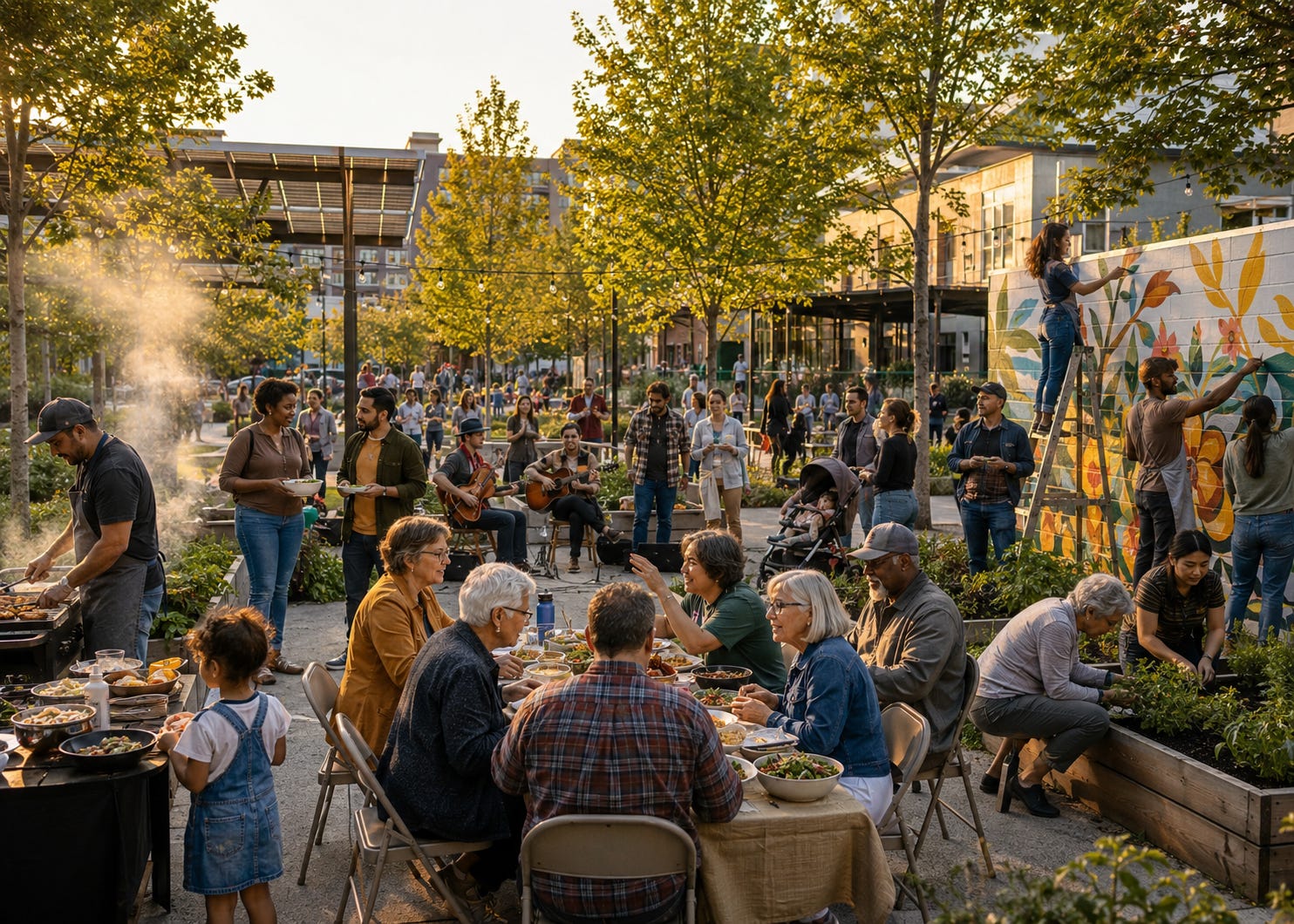
Our new declaration need to come from the United People of the United States of America. It cannot come from Democrats or Republicans, nor people who believe America was once perfect nor people who believe it was corrupt from the beginning. Instead, our declaration comes from those of us who intend to remain part of a shared political future. This is for all of us who want to leave a legacy we can feel proud of to future generations.
I think that our new declaration ought to be addressed to our governments at every level, our political parties, our media systems, the corporations, lobbyists and institutions that depend on our votes, money, labor, and attention.
And the declaration will also be to one another, uniting us in our commitment to build a better future together.
What Would We Declare?
We might want to restate some of the original values:
that all people are created equal;
that we possess unalienable rights to life, liberty, and the pursuit of happiness;
that governments exist to secure those rights;
and that their just powers derive from the consent of the governed (they work for us, at our discretion).
And perhaps it would add a few truths the last 250 years have taught us:
that people deserve a meaningful voice in the decisions shaping their lives;
that no party, government, corporation, media system, or concentrated interest should dominate the rest of us;
and that disagreement should not disqualify anyone from belonging to the political community.
We would then name the widening gap between those values and our present reality: politicians who claim to represent us while leaving millions unheard, institutions that profit from division, political processes that reduce complex questions to winner-take-all contests, and a public sphere increasingly organized around extracting our votes, money, outrage, and attention.
At some point, the people have the right and duty to alter a government that now no longer serves us. We don’t need to agree about everything the government should do, but I think we can agree that it should work and that it works for us.
We do not need to agree about everything government should do. But surely we can agree that it should work, that it should work for us, and that when it repeatedly fails to do so, the people have the right to say: Get your shit together.
What Would We Pledge?
The Declaration of Independence ended with a pledge: “we mutually pledge to each other our Lives, our Fortunes and our sacred Honor.”
That final line reveals something easy to miss. American independence required a commitment to interdependence from the beginning. The colonies could only separate from Britain by committing themselves to one another.
Interdependence is not the opposite of independence. It is the recognition that independent people still share institutions, consequences, and a future. Our task is to decide whether we are willing to remain united across our differences, refuse their endless exploitation, and accept some responsibility for making this experiment work.
This weekend, Braver Angels offered one place to begin:
“I pledge to be a Courageous Citizen: to choose curious listening over contempt; to build alongside those with different politics; and to embrace our shared duty to renew America’s civic culture.”
You can join me in signing the Courageous Citizen Pledge.
We are not being asked to go to war. But democratic renewal will still require courage and discomfort. We may have to speak with people we have learned to avoid, listen to arguments we dislike, acknowledge our own participation in the problem, and occasionally change our minds.
America at 500
The United States will turn 500 in 2276.
That date feels almost absurdly distant. We cannot imagine its technologies, crises, institutions, or culture any more clearly than the people of 1776 could have imagined ours. But they did not need to predict the future. They created a constitutional framework that later generations could amend, interpret, and improve.
Their achievement was not building a system that would remain unchanged for 250 years. It was building one capable of surviving change.
No one seriously believes we can white-knuckle our current system through another 250 years exactly as it is. Continuity will require transformation.
America once helped demonstrate that a brand new idea (constitutional self-government) was possible. If we can now learn how to renew a divided democracy without abandoning it, we may again offer the world something it urgently needs: not less democracy in response to democratic failure, but a more capable democracy that can hold complexity.
The question is not whether we can design a perfect system for 2276. It is whether we can recommit ourselves to developing a democracy that can learn, adapt, and remain accountable through whatever comes next.
We do not have to solve all of that now. The founders did not begin with the Constitution.
They began with a declaration.
I happen to own 2276.us, and I’m building it as a place where we can begin that work together. Not a prediction of the future, but an invitation into it — a growing, nonpartisan archive where anyone can name the principles that should guide the next American chapter, imagine what a new declaration might contain, and picture the kinds of democratic design that could carry the experiment all the way to its 500th anniversary. None of us has to hold the whole answer. We only have to be willing to imagine it alongside people we don’t already agree with.
What Would It Actually Mean to Make America Great Again?
After this weekend in Philadelphia, I feel more committed than ever to asking this question seriously: what would it actually take to make America great again?
We can affirm that something historically great began here 250 years ago without pretending it was perfect. A people declared that government must answer to human equality, rights, and consent, then began the difficult work of building institutions around those principles. We must also be honest about where America betrayed those ideals, why so many people no longer experience the country or its government as great, and whether the next form of American greatness will look anything like the last.
Before we can design that future, we have to decide that we still want to build one together. We have to remain a people, declare what our government is for, name where it is failing, and pledge ourselves to the uncomfortable work of listening, learning, changing, and acting across our differences.
Two hundred and fifty years ago, Americans declared their independence. Perhaps the next chapter begins when the united people of the United States declare their interdependence.
We belong to one another. And the future is still ours to build.
WELL SAID TRUTHS. CLEAR, CONCISE, INSPIRING & CHALLENGING.
I'M IN!
Duncan, this is an excellent article. Thanks for presenting it. You make so many good points. There is a key element in the original declaration that is missing from The quest for a new declaration, and that is the centrality of the Creator.
The “self-evident” truth is that our rights do not originate with government or democratic consensus, but they are endowed to us by the one who created us. I would love to hear your thoughts on the role of this truth in the drafting of a new declaration. Much love. Michael