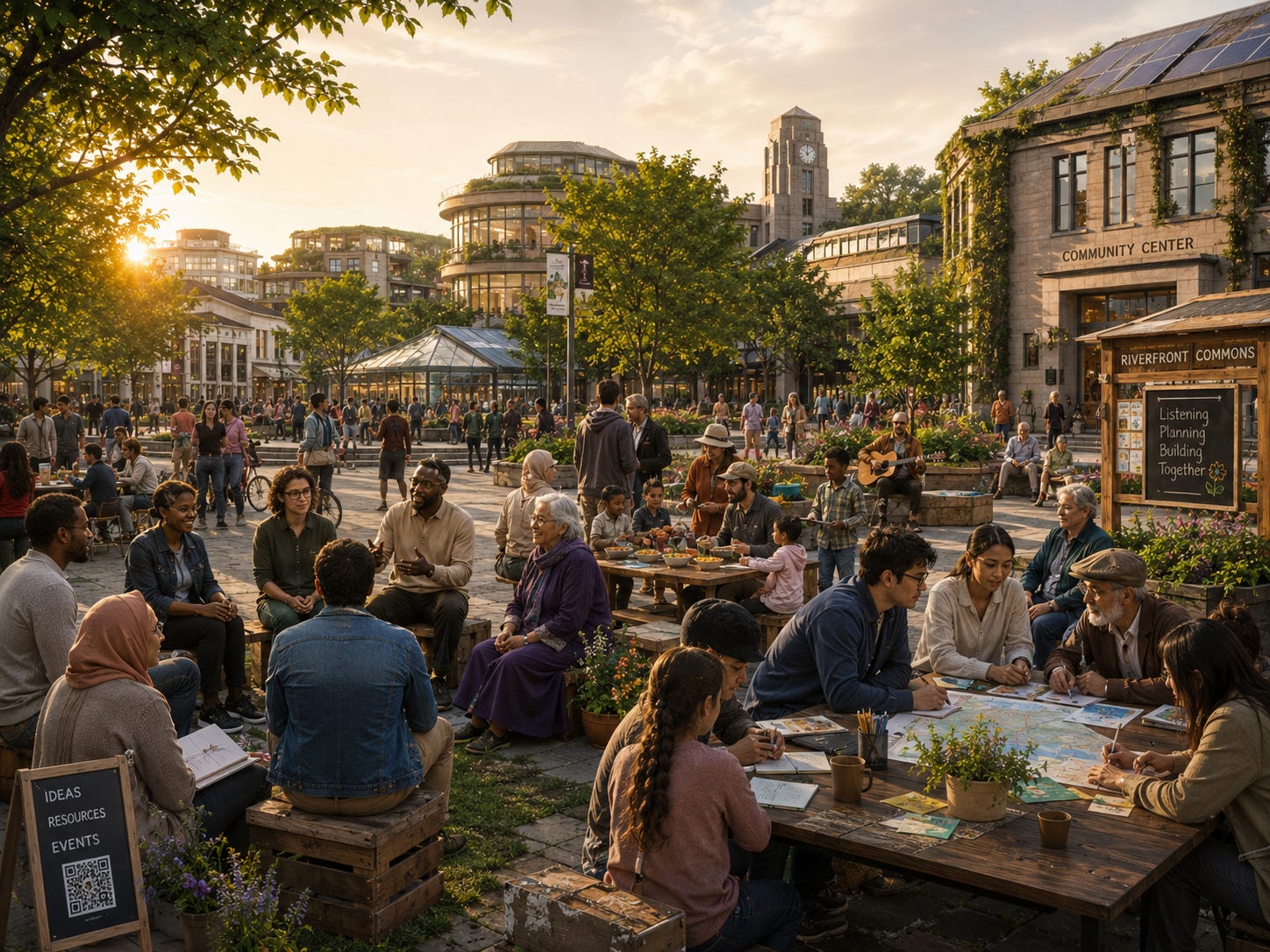
What Will Historians Say About Us?
Introducing 2276.us, a place to imagine America’s next 250 years
America almost didn’t make it.
That is the sentence I keep imagining future historians writing in 2276. Not as prophecy, not as threat, and not as a patriotic doomsday fantasy. More like a sentence written with the relief of distance: America almost didn’t make it through the early twenty-first century. Its institutions were brittle. Its people were distrustful and exhausted. Its information systems rewarded outrage faster than wisdom. Its politics kept turning complexity into combat. Its citizens could feel that something was wrong, but struggled to imagine what could be better.
And then, somehow, something changed.
Not all at once. Not because one leader fixed it. Not because one party finally defeated the other forever. Not because everyone suddenly agreed. But because enough people remembered that democracy was never supposed to be a finished product. It was an experiment, a practice, a promise, and a system for continuing the conversation when the answers are not yet known.
That is the future I want to imagine.
And today, for the Fourth of July, I’m launching a small experiment to help us practice imagining it together.
It’s called 2276.us.
The Future Is Hard to Imagine
Earlier this week, I wrote that the United States may need a new declaration. Not a declaration of independence from one another, but something closer to a declaration of interdependence: a way for the people of this country to name what we still value, where our systems are failing, and what we are willing to build together.
But before a people can declare a future, they have to be able to imagine one. That is the part I keep getting stuck on.
Americans are not short on dissatisfaction. We are very good at being disappointed in the country. We are very good at being angry at the people in charge. We are very good at naming hypocrisy, corruption, dysfunction, bad incentives, institutional decay, elite capture, economic pressure, media manipulation, and all the ways the system does not seem to be working for ordinary people.
We can imagine decline. We can imagine collapse. We can imagine authoritarianism, fragmentation, civil conflict, technological chaos, and everyone becoming more suspicious of everyone else forever. We can imagine a lot of bad endings.
For some reason, we are much less practiced at imagining democratic renewal.
I do not mean vague hope or sentimental optimism. I do not mean pretending that everything will work out somehow. I mean concrete civic imagination. What would a more capable democracy actually feel like? What would make people feel meaningfully represented? What would help us disagree without treating each other as enemies of the future? What institutions would be worthy of trust? What would make government feel like it works for us again? What civic habits would help a free people remain free?
These are not easy questions. But I think they may be some of the most important questions in American life, because if we cannot imagine democratic renewal, we will not build it.
The Declaration Came Before the Design
One of the things that keeps striking me about the founding is that the Declaration came before the design. The founders did not begin with the Constitution. They began with a declaration.
That matters.
The Declaration of Independence did not create a legislature, establish a court system, solve federalism, design the presidency, create the Bill of Rights, or prove that the new country could survive partisan conflict. It did something prior to all of that. It named values. It named grievances. It named the gap between what people believed and what the existing system had become. And it declared that the gap had become intolerable.
The design came later. The Constitution came later. The Bill of Rights came later. The peaceful transfer of power came later. The slow, painful, unfinished expansion of the meaning of “we the people” came much later. And that process is still not finished.
This is important because I do not think we need to redesign the whole country overnight. We do not need to know exactly what American democracy should look like in 2050, much less 2276. We do not need to have all the answers. But we do need to recover the capacity to say, together: this is what we value, this is where our systems are failing those values, this is what we are no longer willing to accept, and this is what we are willing to build toward.
Recognition comes before design. And imagination comes before recognition.
Values Larger Than Ourselves
Of course, the Declaration itself was born inside a contradiction so large it nearly breaks the page. The men who declared that “all men are created equal” did not live as if all people were created equal. Many of them owned human beings. Women were excluded from political life. Indigenous nations were treated not as sovereign peoples, but as obstacles to expansion. The founding promise was real, and so was the hypocrisy.
Frederick Douglass saw this with devastating clarity. In 1852, in the speech now remembered as “What to the Slave Is the Fourth of July?”, he asked what Independence Day meant to those still enslaved. His answer was not gentle. He exposed the moral obscenity of a nation celebrating liberty while denying it to millions.
But Douglass did not respond by saying the principles were meaningless. He treated them as real enough to indict the nation.
That may be one of the strange powers of a declaration. A real declaration is not merely a description of who we already are. It is a standard set beyond ourselves. The Declaration mattered not because its authors fully lived up to it. They obviously did not. It mattered because they gave future generations a standard by which to judge the country, challenge it, correct it, and expand the meaning of its promises.
The best values are often larger than the people who first declare them. That is not an excuse for hypocrisy. It is a responsibility.
If we declare values we already perfectly embody, we are probably not declaring very much. The question is whether we can name principles worthy enough that future generations might use them to call us forward. Think “stretch goals.”
Introducing the Archive of the Future 2276.us
So here is the thought experiment.
Imagine it is the year 2276. The United States is celebrating its 500th anniversary. Historians agree that the country almost did not make it through the early twenty-first century. The 2020s were marked by distrust, institutional decay, democratic fatigue, technological upheaval, and deep uncertainty. People were angry. People were lonely. People were losing faith that the system could adapt.
But somehow, Americans changed course. The republic adapted. Democracy matured. Conflict became a source of renewal rather than collapse. People found meaningful ways to participate in decisions that affected their lives. Institutions became more responsive, more trustworthy, and more capable of learning. The country remained free and pluralistic through centuries of technological, ecological, cultural, and political transformation.
What happened? What did we finally learn? What did we redesign? What did we preserve? What did we stop tolerating? What did we start practicing? What principles did we finally grow into? What did future generations thank us for?
That is the question behind 2276.us.
Today I am launching 2276.us as a public invitation to imagine the second half of the American experiment. It is not a prediction market, a campaign, a think tank, or a social media platform. It is not a place to win arguments about the news cycle.
It is a civic imagination laboratory. A public archive of possible futures. A museum of the future we might still choose to build.
Anyone can read it. Anyone can contribute. You can write under your name, a pseudonym, or anonymously. You can submit an essay, a story, a speculative history, a constitutional idea, a civic ritual, a redesigned institution, a cultural practice, a question, a principle, a warning, a hope, or a vision of how we made it.
The goal is not consensus. The goal is imagination.
Because maybe before we can build better democratic systems, we need more people practicing the ability to imagine them. And because imagination is not separate from politics. A constitution is imagination written into law. A court system is imagination written into procedure. A public school is imagination written into brick and curriculum. A peaceful transfer of power is imagination written into civic habit.
Every institution we take for granted began as something people had to imagine before anyone could build it. And every failing institution is, in part, an old imagination that no longer fits the complexity of the world it is trying to serve.
A Different Kind of Online Space
I also wanted 2276.us to feel different from the internet we are used to.
So there are no likes, no upvotes, and no popularity rankings. There is no incentive to perform certainty for applause.
Instead, readers can respond with reflective reactions: Resonates, Expands the Future, Raises New Questions, Challenges Me, and Worth Preserving. Nothing is ranked by popularity.
That matters to me because the point of this project is not to find the most viral vision of the future. It is to create a quieter place where people can think slowly, imagine generously, and leave something behind for others to build on.
Over time, I hope the archive will be able to reflect patterns back to us. What themes keep recurring? What values show up across ideological differences? What tensions are real and unresolved? Where do people who disagree still seem to be reaching for something similar? What principles might be emerging from the scattered imagination of a people that has not yet given up on itself?
I do not know what this project will become. That is part of the experiment.
You Do Not Have to Imagine All of 2276
I know 2276 is a mind-bender. That is part of the point.
Almost no one can put their feet fully in the shoes of people living 250 years from now. The people of 1776 could not have imagined us either. They could not have imagined the internet, nuclear weapons, artificial intelligence, antibiotics, airplanes, satellites, climate change, social media, or a country where the descendants of enslaved people, immigrants from every continent, Indigenous nations, women, religious minorities, and people of every background would still be struggling, arguing, building, and belonging inside the same unfinished experiment.
They could not imagine us. But they did not need to.
They needed to build foundations that could survive change.
So you do not have to imagine all of 2276. Start smaller. Name one thing you hope future generations will say we finally learned how to do. Name one institution we redesigned. Name one civic habit we recovered. Name one conflict we learned to hold differently. Name one democratic capacity we developed. Name one technology we learned to govern wisely. Name one ritual that helped people remember they belonged to something larger than their faction. Name one principle worth preserving. Name one value we may not yet know how to embody, but should declare anyway.
You do not have to predict the future. You only have to leave one good question, one good story, one good foundation, or one good possibility for others to build on.
This Is Not Partisan
2276.us is nonpartisan by design. Maybe transpartisan is the better word.
It is not built on the assumption that one side of the country has all the answers and the other side is the obstacle to the future. That assumption is part of what has brought us here. The project begins from a different premise: everyone who intends to remain part of a shared American future has a stake in imagining what that future could become.
That does not mean our differences are small. They are not. It does not mean all ideas are equally wise, humane, or democratic. They are not. It does not mean pretending away injustice, power, history, or harm. We cannot.
It means refusing to let our differences prevent us from asking a deeper question: what kinds of democratic foundations could help a free, pluralistic society hold real difference without breaking itself apart?
If everyone is affected by the future, then everyone has some place in the work of imagining it. And the way we imagine together already shapes the kind of future we are creating.
A Small Contribution to a Much Larger Field
This project is not emerging in isolation. There are already people and organizations working to stretch democratic imagination beyond the next election cycle. Some are looking toward 2050. Some are looking toward 2076, the country’s 300th anniversary. Some are focused on America’s 250th and asking what this milestone should mean. Some are building new tools for dialogue, deliberation, civic education, democratic innovation, local participation, institutional reform, and cultural repair.
2276.us is one small contribution to that larger field. Its particular offering is the 500-year arc:
1776 → 2026 → 2276
A way of remembering that we are not only inheritors of a past. We are ancestors of a future. And whether we like it or not, we are leaving something behind.
The question is whether we will do so consciously.
An Invitation
So here is my invitation for this Fourth of July.
Go to 2276.us. Explore the archive, and contribute a vision or principle that might guide us into the next 250.
It does not have to be perfect. It does not have to be comprehensive. It does not have to solve America. It does not have to sound like policy. It does not have to predict the future.
It only has to offer something worth preserving: a principle, a story, a redesigned institution, a civic ritual, a speculative history, a question future generations might thank us for asking, or a value we may not yet know how to live into.
And then share it with someone else. Someone who is tired of doom. Someone who is frustrated but not ready to give up. Someone who loves this country, or wants to, or is angry because it has not yet become what it promised to be.
And if you have ideas for what this project could become, leave a comment or reach out. I am launching it as a seed, not a finished institution.
We have 250 years to develop it.
Kidding.
Mostly.